Cambodia’s Vanishing Grass, Vanishing Craft: Broom-Making Swept Away in Siem Reap
By Zul Rorvy Cambodianess September 16, 2025
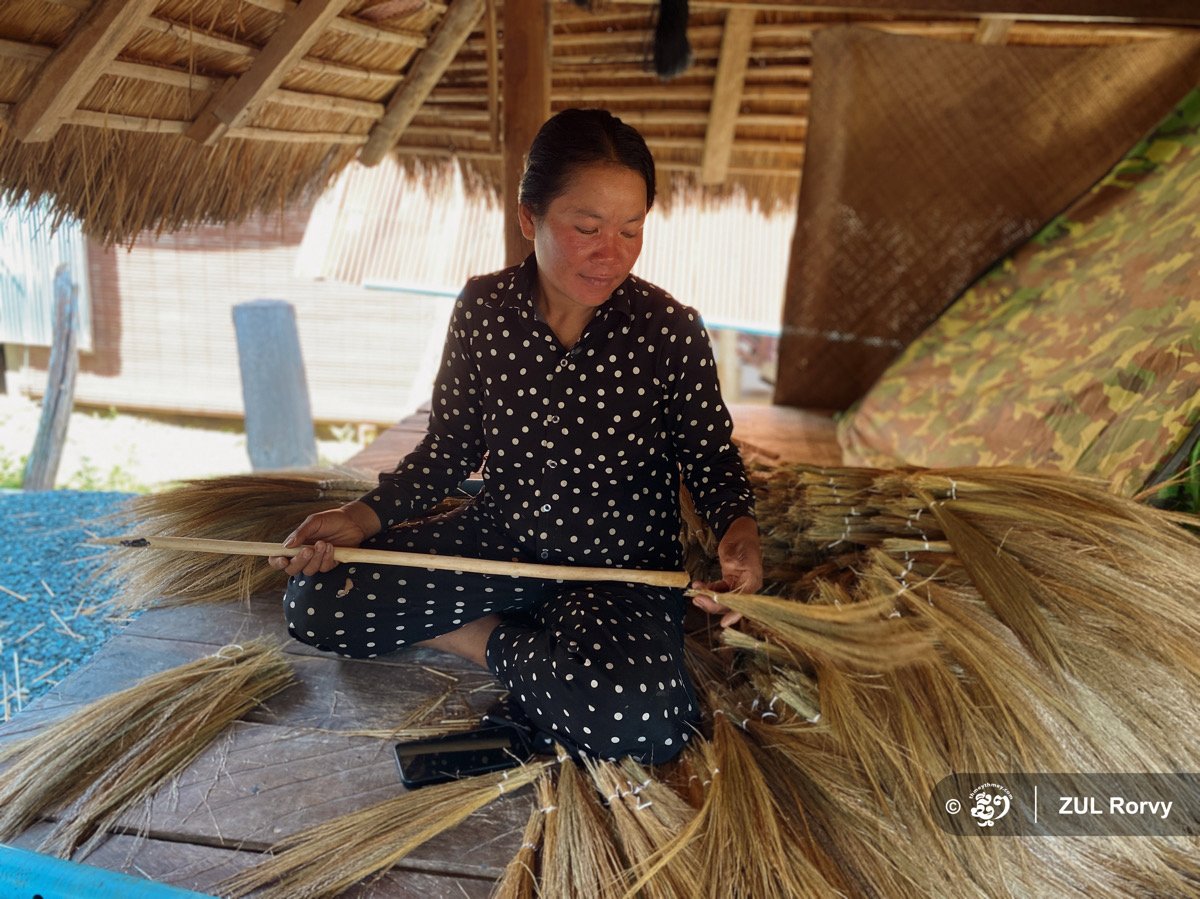
In villages across Siem Reap province, the once-common sight of handmade brooms drying under stilted houses is becoming rare, as the natural broom grass used to make them is disappearing due to expanding farmland.
Among those still keeping it alive is Sam Te, a lifelong resident of Chan Sa Khang Cheung village in Chan Sa commune.
SIEM REAP — In villages across Siem Reap province, the once-common sight of handmade brooms drying under stilted houses is becoming rare, as the natural broom grass used to make them is disappearing due to expanding farmland.
The flower of the broom grass plant—an essential material for traditional broom-making—is becoming increasingly difficult to find. And as the grass vanishes, so too does a generations-old craft that once flourished across districts like Puok, Banteay Srey, and Soutr Nikom.
Today, broom-making survives in only a few households, often as a side activity to farming. In Soutr Nikom district, the tradition is nearing extinction.
Among those still keeping it alive is Sam Te, a lifelong resident of Chan Sa Khang Cheung village in Chan Sa commune. For more than 30 years, she has crafted brooms by hand, continuing a skill passed down from her mother. She either makes them from scratch or finishes ones started by others in her village.
“Back then, almost every house in the village made brooms. You’d see them lined up under stilted homes, drying in the sun,” Te recalled.
“But now, broom grass is so hard to find that most people have stopped. Only a few families are still doing it to earn a living.”
She remembers when broom grass flowers grew abundantly in the fields and roadsides surrounding her village. But over the years, open spaces have been steadily cleared for farmland and rubber plantations.
“There’s no more vacant land like before,” she said. “The demand for farmland has pushed out the natural grasslands where broom grass used to grow.”
Now, gathering raw materials means traveling long distances. During the broom grass flowering season—usually between September and October—Te and other dedicated artisans journey as far as Pursat province to harvest the grass. The trip can take over a month, with time needed to cut, dry, and bundle the broom grass before hauling it back to Siem Reap.
“The work is getting harder every year,” Te said. “Maybe I’ll keep doing this until there are no more broom grass flowers left.”
Despite these challenges, Te remains committed to her craft—not just because it provides income, but because she believes it’s worth preserving.
“Broom-making is good, honest work,” she said. “It helps us earn money, but more importantly, it keeps our identity and traditions alive.”
SOURCE: Cambodianess, Cambodia, September 16, 2025


Recent Comments