Beijing exhibition brings ancient Angkor back to life
Taing Rinith / Khmer Times Mon, April 27, 2026
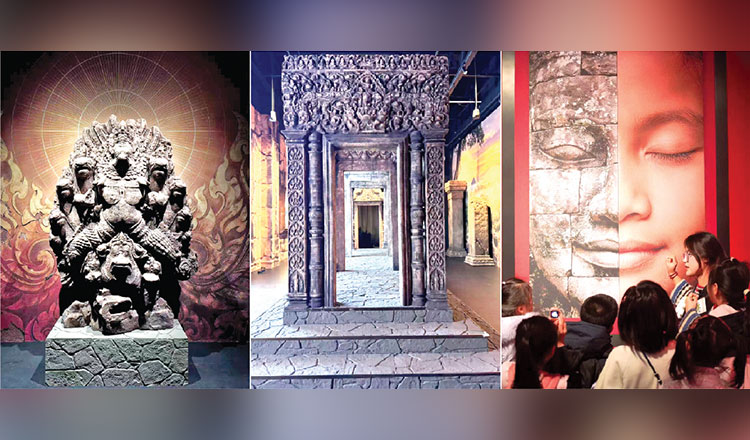
In a darkened gallery in the Chinese capital of Beijing, the ancient Khmer Empire breathes again. Temple walls glow, celestial dancers move in light, and a 13th-century traveller quietly guides visitors through a civilisation that once stood at the heart of Southeast Asia.
“The Smile of Angkor” exhibition, an ambitious, immersive showcase that is introducing Chinese audiences to the depth, beauty, and sophistication of Cambodia’s cultural heritage—without them having to leave Beijing.
Staged at UCP Digital Art Centre, the exhibition transforms more than 2,000 square metres into a living narrative of Angkor, drawing heavily on the writings of Zhou Daguan, the Chinese envoy who visited the Khmer Empire in 1296.
Zhou’s accounts are one of the most detailed foreign records of Angkor at its height. His observations of daily life, grand temples, and court rituals now serve as the storytelling backbone of the exhibition, creating an immediate cultural bridge between past and present—and China and Cambodia.
Visitors follow his journey as if retracing his footsteps, moving through digital recreations of bustling ancient streets, sacred spaces, and royal ceremonies. In doing so, they encounter not just monuments but also a living civilisation.
At the heart of the exhibition is Angkor Wat, reimagined through projection, sound, and spatial design. Its iconic symmetry and spiritual symbolism are brought into sharp focus, allowing audiences unfamiliar with Cambodia to grasp both its scale and its meaning.
What sets “The Smile of Angkor” apart is its fusion of cutting-edge digital technology with cultural elements. Replica sculptures—such as the sacred naga serpents—stand alongside immersive projections, while holographic performances evoke the elegance of Apsara dance.
A striking four-faced Buddha installation introduces visitors to the four immeasurables of Buddhist philosophy: lovingkindness, compassion, sympathetic joy, and equanimity. These spiritual concepts, deeply embedded in Khmer culture, are presented in a way that is both accessible and visually compelling.
Rather than presenting history as static, the exhibition invites interaction—encouraging visitors to engage, explore and reflect. It is this blending of art, narrative and technology that makes the experience resonate with modern audiences.
Beyond its visual spectacle, the exhibition carries a deeper purpose: cultural diplomacy. Developed through collaboration between Cambodian and Chinese partners, including X Capital, the project aims to position Cambodia’s heritage on the global stage.
Chinese artists travelled to Cambodia to conduct on-site research, working closely with Cambodian experts to ensure authenticity. The result is not merely an interpretation of Angkor but a shared cultural effort that reflects mutual respect and curiosity.
For Cambodian organisers, the goal is clear—use digital innovation to tell Khmer stories to the world.
The project’s early impact has been significant. Within just two months of its launch in January 2026, it generated around 40 million online impressions, signalling strong interest among Chinese audiences and beyond.
Running in Beijing until June, the exhibition is only the beginning. Plans are already in place for it to tour other provinces in China and potentially expand internationally—bringing Angkor’s legacy to even wider audiences.
https://www.khmertimeskh.com/501886606/beijing-exhibition-brings-ancient-angkor-back-to-life/?fbclid=IwY2xjawRcGFVleHRuA2FlbQIxMABicmlkETBJY3BDanJQYnFrV2VIYnE0c3J0YwZhcHBfaWQQMjIyMDM5MTc4ODIwMDg5MgABHoRYQerN7OBkoM2I3N-1S8-06hVvRRVDPRkO9c–6wV7CZGES9Ez11mtxYVh_aem_UBUn-9VBeGYEa2a1uMxHIA


Recent Comments