Cambodia – Small payments fuel wider corruption, expert warns
Som Sotheary / Khmer Times April 28, 2026
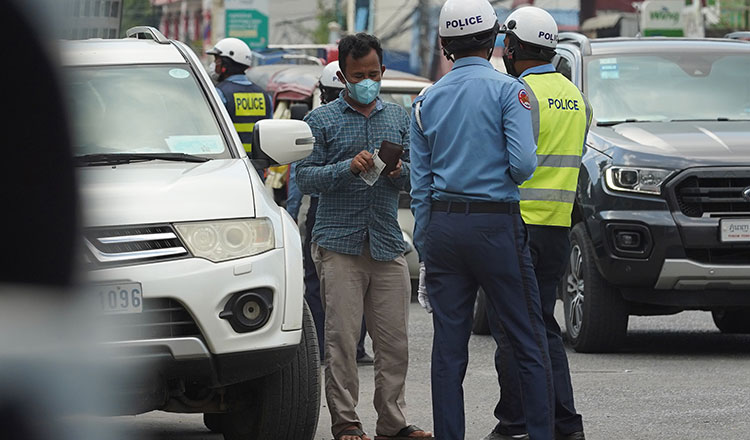
A motorist faces a traffic stop in Phnom Penh. Khmer Times
Small, unofficial payments for routine public services are fuelling broader corruption in Cambodia, where weak enforcement, low public awareness, and a fear of reporting continue to undermine anti-corruption efforts, a civil society leader said.
Sin Putheary, Executive Director of Transparency International (TI) Cambodia, said corruption remains embedded in public life despite legal and institutional frameworks introduced over the past decade.
Speaking on Cross-Talk, she noted that corruption continues to hinder governance, socioeconomic development, and public trust in state institutions.
On the TI Corruption Perceptions Index (CPI) in 2025, Cambodia scored 20 out of 100 points, down from 21 points in 2024. Cambodia’s score has remained in the low 20s for more than a decade.
The CPI ranks 182 countries and territories based on perceived levels of public sector corruption, with scores ranging from zero (highly corrupt) to 100 (very clean).
She added that the problem is not confined to Cambodia. This year, the CPI global average stands at 42—the lowest in over a decade—with more than two-thirds of countries scoring below 50.
“This is not only happening in Cambodia,” she said. “The 2025 global context shows that corruption has become more widespread globally compared to 2024, with a large number of countries scoring below 50.”
Transparency International Cambodia Executive Director Sin Putheary speaks on Cross-Talk. KT/Pann Rachana
Putheary pointed out that Cambodia has established the necessary legal foundations, including the 2010 Anti-Corruption Law and specific investigative bodies. The law provides a broad definition of the issue. “According to the law, there are 38 types of corruption, involving bribery and abuse of power, among others,” she said, adding that these crimes have far-reaching impacts on society.
However, she added that enforcement remains the primary challenge. Corruption cannot be addressed through legislation alone; it requires participation from all levels of society.
“Corruption is broad in nature; therefore, law or punishment alone is not sufficient. It often starts small—within families and small communities—before expanding to the national and eventually global level,” she said.
Small, informal payments for public services are a particular concern for governance. “Even small irregularities in public services can affect the interests of society as a whole,” Putheary added.
While corruption exists across all sectors, she believes public services are the most sensitive area due to their direct impact on citizens’ lives.
She noted that governance and the rule of law are essential to reduce corruption, and that when these elements are missing, “problems inevitably arise.”
Putheary identified social attitudes as a major hurdle, noting that corruption is “often difficult to identify because it is not always visible in physical form.”
“This relates to the mindset of citizens and, most importantly, to awareness. We need to educate people on what corruption actually is, as the concept can be quite abstract,” she said.
Public participation is essential, particularly in monitoring and reporting irregularities. “Participation means helping to monitor one another. When people express dissatisfaction or protest regarding public service delivery, they are helping to identify what is wrong. By doing so, they take part in correcting those problems.”
Ultimately, Putheary said policy implementation is the most critical factor.
“Laws must be enforced equally and transparently. It will not work if the government, citizens, or civil society organisations act in isolation. Strong participation from all sides is necessary,” she said.
She added that transparency regarding enforcement outcomes is vital for building public trust. “We must be honest about what is still pending and what has not been done well. If we do not discuss these gaps and find solutions, the problems will continue.”
According to the Anti-Corruption Unit (ACU), it has recently carried out extensive educational activities both within and outside of schools, focusing on raising awareness among students, civil servants, and the general public.
Putheary said civil society plays a crucial role in ensuring compliance. “Our main role is to observe and help monitor whether implementation is correct.”
She urged citizens to reject the status quo. “First, we should not actively participate in corruption. If we engage in it despite knowing it is wrong, we only strengthen the system and add to the collective burden.”
She encouraged the public to report irregularities but warned that a lack of trust in the system often discourages whistleblowers.
“People must trust that when they report corruption, they will be protected and recognised for helping society. If they do not trust the system, they will not participate—and without participation, there will be no success.”
Putheary cited international examples, such as Singapore and various European nations, which have achieved positive outcomes through robust governance. She said reducing corruption is a collective responsibility.
“We all know corruption is harmful to society, the economy, and politics. Therefore, everyone must do their part to end it.”


Recent Comments