Thailand’s Mani youth blend forest shelter traditions with modern education
By Khaosod English Mon, May 25, 2026
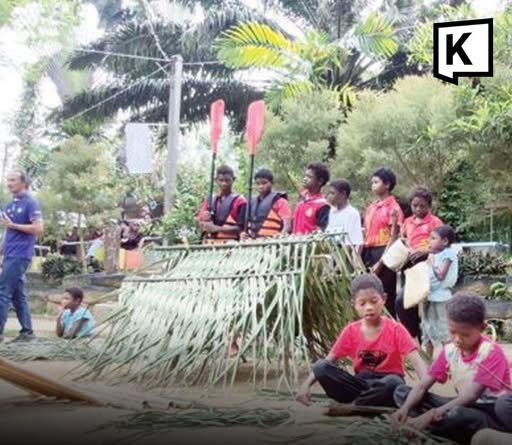
SATUN — Children from Thailand’s Mani ethnic minority, an Indigenous forest-dwelling community in southern Thailand, are blending traditional survival skills with modern education through cultural demonstrations aimed at preserving their heritage while adapting to life beyond the forest
At Ban Wang Sai Thong tourist attraction in Satun province, Mani schoolchildren dressed in school uniforms and sportswear demonstrated how to build a traditional temporary shelter known as a “thap”, attracting attention from visitors.
The activity was organised by Ban Wang Sai Thong School, where Mani children showcased traditional knowledge passed down through generations.
The students demonstrated how to construct shelters using overlapping leaves for protection from sun and rain, light fires for warmth, and roast wild yams, a staple food traditionally gathered from underground. They also displayed traditional hunting tools used by their ancestors
Prapha, a teacher closely involved with the students and known locally as “Teacher Toi”, said the demonstrations reflected skills deeply rooted in the children’s daily lives.
“This is 100% natural for them because it is how they actually live in the forest,” she said. “The school simply helps fill in what is missing, including education, social skills and communication abilities, so they can confidently welcome tourists and explain their culture.”
Beyond the traditional skills, teachers said the children were also developing ambitions for the future.
One student, identified as Jub, said she hoped to become a nurse to care for her frequently ill parents, while several classmates expressed dreams of becoming athletes.
The students admitted studying at school was more difficult than building shelters, but said they enjoyed learning and wanted broader opportunities in the future…. อ่านข่าวต้นฉบับได้ที่ :
Teachers said many Mani children had gradually adapted to wider society and earned small incomes by helping clean community areas or rowing boats for tourists.
However, access to education remained limited because most families lived in temporary shelters without electricity or internet access.
“Homework can mostly be done only at school because their shelters have no electricity or internet access,” Prapha said, adding that basic supplies such as pencils, erasers and notebooks were still lacking.
Prapha currently oversees 43 Mani children ranging from kindergarten to primary school level.
Teachers said encouraging the children to confidently present their traditional way of life not only helped support community tourism but also strengthened their ability to adapt to modern society without losing their cultural identity.
https://www.khaosodenglish.com/life/https://www.khaosodenglish.com/life/2026/05/25/mani-youth-blend-forest-shelter-traditions-with-modern-education/?fbclid=IwY2xjawSA9E9leHRuA2FlbQIxMABicmlkETBXa000NHgybEhyekM2RnNJc3J0YwZhcHBfaWQQMjIyMDM5MTc4ODIwMDg5MgABHoOKHw4JbSsgU564Pw2nC3EmA9UN6ppJdRtWCmSq5NGloVrAjFHYxBDGZQwl_aem_ZvTvueHX5mDMvG4CPcMNBw


Recent Comments