Cambodia–Thailand OCA tensions expose ASEAN governance gaps, notes former diplomat
Raksmey Hong The Phnom Pen Post Sat, May 16, 2026
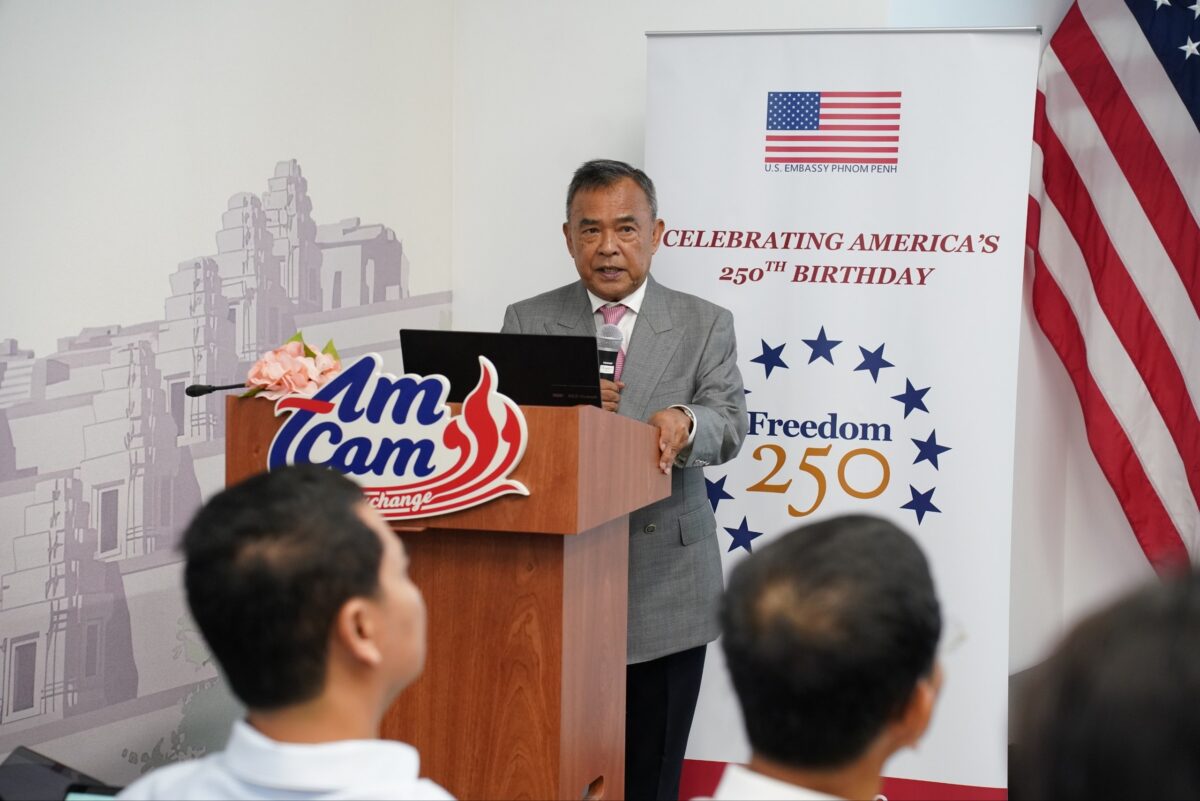
Former Cambodian diplomat Pou Sothirak addresses the “Cambodia-Thailand Maritime Overlapping Claims Area (OCA): Issues and Consequences” dialogue at the AmCam Exchange on May 15. SuppliedShare
Former Cambodian diplomat Pou Sothirak has warned that rising tensions over the Cambodia–Thailand Maritime Overlapping Claims Area (OCA) are exposing deeper weaknesses in ASEAN’s ability to manage regional maritime disputes. At the same time, he urged both sides to avoid inflammatory rhetoric and pursue dialogue.
While addressing the May 15 “Cambodia-Thailand Maritime Overlapping Claims Area (OCA): Issues and Consequences” dialogue at the AmCam Exchange, Pou explained his belief that the current dispute highlights the lack of robust regional mechanisms governing maritime disputes compared to long-established frameworks for land borders.
“Cambodia poses no sovereignty threat to Thailand, either on lan or the maritime sphere,” he said, adding that Cambodia has “no ambitions to take over what does not legally belong to us” but retains the responsibility to protect what it considers its lawful sovereign rights.
His remarks came after Thailand cancelled a 2001 Memorandum of Understanding (MOU) on maritime overlapping claims earlier this month.
Pou suggested the disagreement reflects competing views over joint development and maritime delimitation, particularly concerning overlapping claims areas and offshore resources.
“The spirit of the MOU,” he said, “was to link joint development with delimitation together”.
Under that framework, some parts of the overlapping claims area could be delimited while others would remain under joint development arrangements, he explained.
However, he acknowledged uncertainty over how Cambodia may proceed legally under the UN Convention on the Law of the Sea (UNCLOS), including whether Phnom Penh would seek compulsory conciliation regarding maritime boundaries or offshore resource rights.
“All I know is that Cambodia want to seek legal interpretation under UNCLOS to protect Cambodian sovereign rights,” he said.
Pou repeatedly emphasised that both countries would suffer from any military escalation at sea.
“If Thailand and Cambodia decide to go to war at sea, both lose,” he said. “There’s no winner in this war.”
He warned that any maritime confrontation would undermine ASEAN’s long-standing identity as a region committed to peace and conflict avoidance.
“ASEAN pride themselves on no war,” he said, while questioning whether the bloc’s dispute settlement mechanisms remain effective.
According to Pou, ASEAN has remained largely stuck at the stage of preventive diplomacy without advancing toward deeper confidence-building or conflict-resolution mechanisms.
“This issue is about trust,” he said, arguing that mistrust between the Thai military and Cambodia has complicated efforts to manage disputes calmly.
At the same time, he stressed that mistrust exists on both sides and cautioned against portraying the issue in simplistic terms.
“Cambodia doesn’t trust Thailand,” he said, highlighting the historical role of the Thai military in shaping foreign policy.
Still, he argued that Cambodia’s approach remains defensive rather than confrontational.
“The Cambodian side is defensive. We never launch attacks,” he said.
Throughout the discussion, Pou urged journalists, researchers and the public to avoid rhetoric that could inflame tensions or derail ongoing diplomacy.
“Please believe in the spirit of collaboration,” he said, warning that misinformation and sensationalism could damage efforts to improve bilateral ties.
“There’s a lot of fake news around, a lot of unfounded claims,” he noted.
He also suggested that both Phnom Penh and Bangkok ultimately share an interest in cooperation and joint development despite political disagreements.
“To be honest with you, I think the Thai government also want joint development,” he said.
Pou further argued that many sensitive issues should be handled through quiet diplomacy rather than public confrontation.
“Some issues are better not discussed publicly,” he said, calling for negotiations through “appropriate level of discussions and platforms”.
The former diplomat also linked the Cambodia–Thailand maritime dispute to broader regional tensions, including ongoing disputes in the South China Sea, warning that miscalculation at sea could trigger wider instability.
While uncertainty remains over whether Cambodia will formally pursue legal mechanisms under UNCLOS, Pou said the coming months would be critical in determining how the dispute evolves and whether both countries can maintain dialogue despite rising political pressure.


Recent Comments