Psar Kramoun Traces Its Origins to the Angkor Period
By Moeun Chhean Nariddh Cambodianess Thu, July 17, 2025
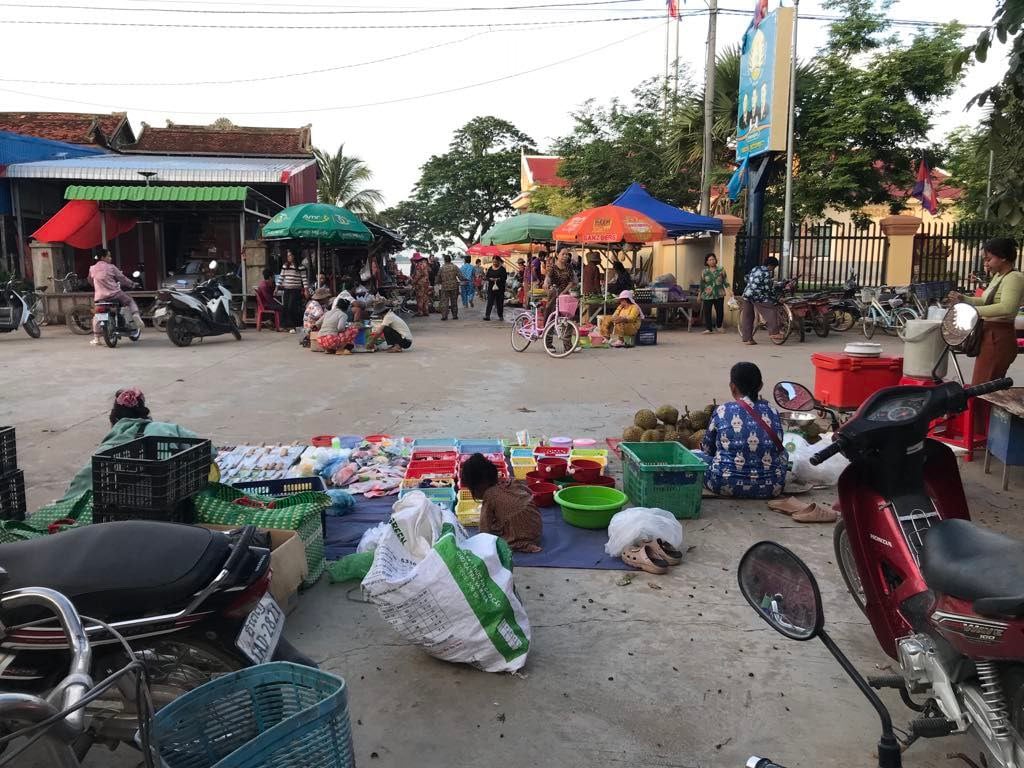
A wax market at 6 am attracts crowds. Photo by Moeun Chhean Nariddh
CHAM – Skip the mega malls or large markets. In the countryside, you can buy food at a Psar Kramoun (literally ‘wax market’) or morning market, with trading traditions dating back to Angkor times.
The term originates from its early start, when the morning is cool, and its closure, when the heat builds up, melting like wax.
Sellers lay out mats on the ground to display their goods, except for some wooden stalls where vendors sell groceries or rice porridge.
Psar Kramoun, located in Kampong Cham province, has remained largely unchanged for hundreds of years. Records say Zhou Daguan, a Chinese diplomat who visited Angkor in 1296, was impressed by the daily markets.
“The local people who know how to trade are all women,” he writes in his memoir for the Chinese Emperor after his year-long stay at Angkor.
“There is a market every day from around six in the morning until midday. There are no stalls, only a kind of mat laid out on the ground. I gather there is a rental fee to be paid to officials.”
Modern Psar Kramoun disappears under the bright sunlight at around 8:00 or 8:30 a.m. One is located in the Kang Meas district, approximately 40 kilometers northeast of Phnom Penh.
“If you want to buy fish or vegetables to cook for lunch, you should come as early as you can,” says Yim Chenda, a 47-year-old vendor who sells groceries and vegetables.
She said this market has remained the same since she got married and started her business 25 years ago.
“Vendors, farmers and fishermen bring their farm produce, fish and meat to sell at the market around 5am,” she said. “Then, they close their stalls around 8am when no more customers come.”
One noticeable aspect is that most vendors at big and small markets in Cambodia are women– a tradition dating back to the Khmer Empire.
Zhou Daguan said the difference was that, in ancient times, customers did not use paper currency.
“Market transactions for items of small value are paid for with rice or other grains,” he wrote. “Higher value transactions are paid for with cloth. The largest transactions are done with gold and silver.”
Whether customers bought goods on credit during the Angkorian period is unknown. However, some villagers at the current morning markets do.
“There are some people who have bought my groceries or vegetables on credit,” said Chenda. “One man came to buy two packs of cigarettes on credit, but he didn’t repay me.”
“But I always pay you every time I buy anything from your stall,” said Eng Vuthy, a 63-year-old farmer who is Chenda’s loyal customer. “And I only come to your stall.
“I am not talking about you,” Chenda replied. “I talk about another man.”
Vuthy said he always buys goods sold by women rather than men in his village.
“Women are cleaner than men and they are also beautiful,” said Vuthy as he steals a glance at Chenda, whom he often flirts with when he comes to buy something.
Vuthy said things at Psar Kramoun are much cheaper than those sold at the big markets or malls.
“Usually, they sell things at half price, because they don’t pay taxes and people catch fish or grow vegetables themselves,” he said.
Bun Yon, a 68-year-old former Buddhist monk, said he prefers buying things sold by men.
“Men never charge a very high price like women,” he said. “And women rarely lower the price when a male customer comes to their stall,” he said.
However, Nhel Sopheak, a 45-year-old drink and fruit seller, rejects Bun Yon’s claim that female vendors overcharge.
“All the customers in the village know the prices of goods very well, so we never set the prices higher than it actually costs,” said the mother of four. “If my goods are only one cent more expensive, they will not buy them.”
Sopheak said women are more attractive than men in persuading customers to buy their goods.
“I once asked my husband to look after our goods when I was busy cooking food,” she said. “But he just sat still like a statue and didn’t care whether any customers were coming to buy anything.”
SOURCE: Cambodianess Thu, July 17, 2025

 ASEAN Digest
Recent Comments